

Where are IPÊ’s restoration projects located?
Hover over the points to learn more about our projects.
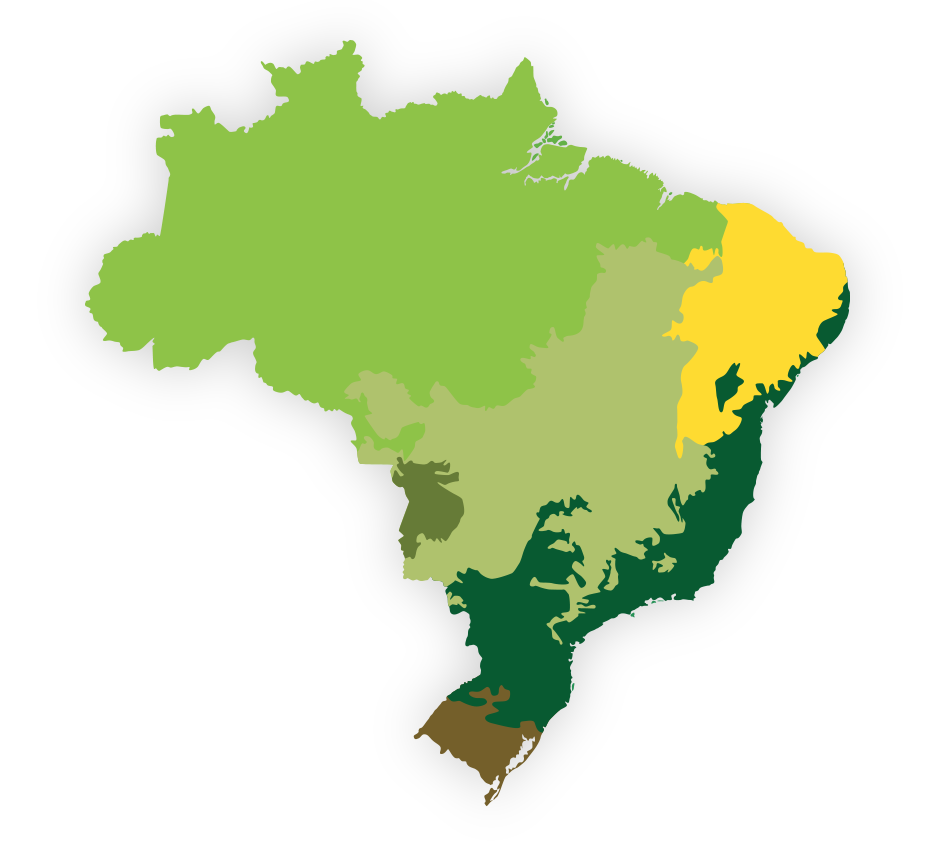
Prospera
Southern Bahia (Prado region)
Prospera – the Project for Sustainable, Production-Oriented Restoration, Environmental Regeneration and Expanded Income – supports rural producers in land-use planning, with the aim of increasing productivity, improving soil quality and enhancing water availability on their properties. It also strengthens the local economy by developing sustainable value chains, sharing knowledge, and promoting benefits for people through biodiversity conservation and climate improvement. All of this is achieved through ecosystem restoration and the productive recovery of a section of the Central Atlantic Forest Corridor, encompassing the municipalities of Prado, Porto Seguro and Itamaraju.
This section of the Central Corridor was selected based on the study ““Biodiversity Corridors – Pathways to Building Sustainable Landscapes”, conducted by IPÊ. It crosses private properties, family farming areas, and Indigenous Lands. With the participation of rural landowners, the focus is on planting and regenerating native forests in Permanent Preservation Areas and Legal Reserves, creating corridors that reconnect Conservation Units.
Sowing Water
Nazaré Paulista and region - SP
The Sowing Water Program works to strengthen the water resilience of the Cantareira System, which supplies more than 7 million people in the São Paulo Metropolitan Region (RMSP). Since 2013, we have developed integrated strategies for water and biodiversity conservation and for reducing the impacts of climate change, while generating socioeconomic benefits for the local population. Our actions focus on expanding the use of soil conservation techniques, as groundwater is the best place to store rainwater. This includes implementing Nature-based Solutions on rural properties, such as the Ecological Restoration of Permanent Preservation Areas and Sustainable Production Systems; encouraging the commercialization of products from regenerative agriculture; providing Climate Environmental Education for young people and adults; and sharing knowledge in an accessible and educational way.
Corridors for Life
Pontal do Paranapanema (western São Paulo)
Since 2000, the Corridors for Life project has planted over 12 million native Atlantic Forest trees across approximately 7,000 hectares—an area equivalent to roughly 7,000 soccer fields. The forests are planted in Permanent Preservation Areas (PPAs) and Legal Reserves on private properties, connecting two protected areas—the Morro do Diabo State Park and the Black Lion Tamarin Ecological Station—and strengthening biodiversity conservation.
The project’s current phase, under the ARR Corridors for Life initiative, aims to sequester 29 million tonnes of CO₂ over 50 years through the restoration of 75,000 priority hectares, within an estimated environmental restoration deficit of 240,000 hectares in the region.
Reflora
Puranga Conquista Sustainable Development Reserve (Lower Rio Negro – AM)
The REFLORA Project restores degraded areas in the Puranga Conquista Sustainable Development Reserve, in the Lower Rio Negro region of Amazonas. The initiative benefits Indigenous and riverside communities, combining biodiversity conservation with socioeconomic development. With a goal of restoring 200 hectares, it relies on agroforestry systems and native species, promoting sustainable income generation and mitigating the effects of climate change in the Amazon.
Where are IPÊ’s restoration projects located?
Hover over the points to learn more about our projects.
Prospera
Southern Bahia (Prado region)
Prospera – the Project for Sustainable, Production-Oriented Restoration, Environmental Regeneration and Expanded Income – supports rural producers in land-use planning, with the aim of increasing productivity, improving soil quality and enhancing water availability on their properties. It also strengthens the local economy by developing sustainable value chains, sharing knowledge, and promoting benefits for people through biodiversity conservation and climate improvement. All of this is achieved through ecosystem restoration and the productive recovery of a section of the Central Atlantic Forest Corridor, encompassing the municipalities of Prado, Porto Seguro and Itamaraju.
This section of the Central Corridor was selected based on the study “Biodiversity Corridors – Pathways to Building Sustainable Landscapes”, conducted by IPÊ. It crosses private properties, family farming areas, and Indigenous Lands. With the participation of rural landowners, the focus is on planting and regenerating native forests in Permanent Preservation Areas and Legal Reserves, creating corridors that reconnect Conservation Units.
Sowing Water
Nazaré Paulista and region - SP
The Sowing Water Program works to strengthen the water resilience of the Cantareira System, which supplies more than 7 million people in the São Paulo Metropolitan Region (RMSP). Since 2013, we have developed integrated strategies for water and biodiversity conservation and for reducing the impacts of climate change, while generating socioeconomic benefits for the local population. Our actions focus on expanding the use of soil conservation techniques, as groundwater is the best place to store rainwater. This includes implementing Nature-based Solutions on rural properties, such as the Ecological Restoration of Permanent Preservation Areas and Sustainable Production Systems; encouraging the commercialization of products from regenerative agriculture; providing Climate Environmental Education for young people and adults; and sharing knowledge in an accessible and educational way.
Corridors for Life
Pontal do Paranapanema (western São Paulo)
Since 2000, the Corridors for Life project has planted over 12 million native Atlantic Forest trees across approximately 7,000 hectares—an area equivalent to roughly 7,000 soccer fields. The forests are planted in Permanent Preservation Areas (PPAs) and Legal Reserves on private properties, connecting two protected areas—the Morro do Diabo State Park and the Black Lion Tamarin Ecological Station—and strengthening biodiversity conservation.
The project’s current phase, under the ARR Corridors for Life initiative, aims to sequester 29 million tonnes of CO₂ over 50 years through the restoration of 75,000 priority hectares, within an estimated environmental restoration deficit of 240,000 hectares in the region.
Reflora
Puranga Conquista Sustainable Development Reserve (Lower Rio Negro – AM)
The REFLORA Project restores degraded areas in the Puranga Conquista Sustainable Development Reserve, in the Lower Rio Negro region of Amazonas. The initiative benefits Indigenous and riverside communities, combining biodiversity conservation with socioeconomic development. With a goal of restoring 200 hectares, it relies on agroforestry systems and native species, promoting sustainable income generation and mitigating the effects of climate change in the Amazon.
Reforestation Meter
trees planted by IPÊ
*as of June 2026
Sustainable Production Systems
hectares restored
families benefited
What is forest restoration and its role in biodiversity
Forest restoration is one of the main strategies for recovering biodiversity in degraded areas, helping restore their structure, ecological functioning, and species composition in ways that bring them closer to their original conditions. It is important for restoring areas ranging from Permanent Preservation Areas and Legal Reserves to protected areas, as well as for connecting large forest areas through green corridors.
This work helps promote essential ecosystem services, such as water production and availability, improved soil quality, pollination, and climate regulation. In addition, forest restoration plays a key role in reconnecting fragmented habitats, facilitating wildlife movement and expanding seed dispersal, thereby contributing to ecosystem balance and the conservation of biological diversity.
The forest restoration approach proposed by IPÊ
For IPÊ, biodiversity conservation is one of the ways to address socioeconomic and climate challenges. We seek to promote forest restoration and habitat recovery in ways that generate direct benefits for Brazil’s biodiversity, the climate, and people.
Across our restoration projects, we work according to several key principles:
Applied innovation in the field
Over more than three decades, our work has drawn on scientific research to guide restoration in practice: territorial mapping to identify priority areas for species survival, such as forest corridors; large-scale planting strategies, as well as small-scale approaches that strengthen agroecology; and the use of technologies to monitor outcomes for flora and fauna, including autonomous audio recorders to detect animal sounds in the forest, camera traps, and remote sensing technologies such as LiDAR to estimate forest biomass and carbon stocks and measure carbon uptake by forests.
Innovation is also social, linking community engagement, environmental education, and income generation to restoration activities.
Partnerships
An effective and successful socio-environmental conservation project depends on the combined efforts of all sectors: government, businesses, and civil society. Designed to endure and deliver long-term results, the forest restoration approach proposed by IPÊ aims to align diverse social interests and priorities to achieve our biodiversity conservation goals. In this way, we connect people and professionals who can become partners and contribute to our mission.
Results that address global needs
One of the global goals for addressing desertification and the climate crisis is the restoration of forest areas. The United Nations designated 2021–2030 as the United Nations Decade on Ecosystem Restoration. Globally, the challenge is to restore 1 billion hectares. Brazil has set a goal of restoring 12 million hectares by 2030, in line with the country’s climate targets. Together with zero illegal deforestation and other targets for reducing greenhouse gas (GHG) emissions, these represent Brazil’s contributions to addressing the climate crisis.
Native and diverse forests matter
Forest restoration must incorporate a diversity of species capable of restoring local biodiversity and providing habitats for wildlife, whether as pathways or places to live. We aim to create forests that attract wildlife, avoiding what we call the “empty forest” effect. We have achieved this in areas where Atlantic Forest corridors have been planted in the Pontal do Paranapanema. In addition to attracting wildlife, we also seek to support the continued presence of traditional communities in their territories by promoting a diversity of species that can generate income through sociobiodiversity products. The proposal is to reconcile forest conservation as a means of attracting wildlife with the development of sustainable economic alternatives for the populations that live within these forests.
Social participation and engagement
Our socio-environmental conservation model sees environmental education and social participation as drivers of transformation. Through our projects, we engage local communities in envisioning and driving the changes they seek for their territories. This approach has contributed to the success of a wide range of initiatives, from restoration-related businesses, such as community and planting nurseries, to seed networks and groups whose activities are connected to socio-environmental conservation, such as the Atlantic Forest embroidery group, whose members draw inspiration from forest biodiversity to create purpose-driven products.
The restoration initiatives we implement also seek to strengthen sociobiodiversity value chains by introducing and managing species of economic value to traditional communities.
The path toward transforming territories into more sustainable places with higher quality of life emerges from the exchange between our professionals and technical experts and local and ancestral knowledge. This connection is key to making a difference
.
Species selected for each region
Amazon
| Common name | Scientific Name | Family |
| Itaúba | Mezilaurus itauba | Lauraceae |
| Jatobá (Indian locust) | Hymenaea courbaril L. | Fabaceae |
| Roxinho/Violeta (Purplehart/Violetwood) | Peltogyne catingae Ducke | Fabaceae |
| Preciosa | Aniba canelilla (H.B.K) Mez. | Lauraceae |
| Pau Rosa (Brazilian rosewood) | Aniba rosaeodora Ducke | Lauraceae |
| Tonka bean | Dipteryx odorata | Fabaceae |
| Rubber tree | Hevea brasiliensis L. | Euphorbiaceae |
| Copaíba | Copaifera multijuga Hayne | Fabaceae |
| Andiroba | Carapa guianensis | Meliaceae |
| Cacao | Theobroma cacao | Malvaceae |
| Mogno brasileiro (Big-leaf mahogany) | Swietenia macrophylla | Meliaceae |
Mata Atlântica
| Common name | Scientific Name | Family |
| Cambuci | Campomanesia phaea (O.Berg) Landrum | Myrtaceae |
| Canela-amarela | Nectandra lanceolata Nees | Lauraceae |
| Grumixama | Eugenia brasiliensis Lam. | Myrtaceae |
| Ipê-rosa (Pink trumpet tree) | Handroanthus impetiginosus (Mart. ex DC.) Mattos | Bignoniaceae |
| Jequitibá-rosa | Cariniana legalis (Mart.) Kuntze | Lecythidaceae |
| Juçara palm | Euterpe edulis Mart. | Arecaceae |
| Manacá-da-serra (Glory bush) | Pleroma mutabile (Vell.) Triana | Melastomataceae |
| Pau-brasil (Brazilwood) | Paubrasilia echinata (Lam.) Gagnon, H.C.Lima & G.P.Lewis | Fabaceae |
| Pau-tucano | Vochysia tucanorum Mart. | Vochysiaceae |
Cerrado
| Common name | Scientific Name | Family |
| Araticum (marolo) | Annona crassiflora Mart. | Annonaceae |
| Barbatimão | Stryphnodendron adstringens (Mart.) Coville | Fabaceae |
| Baru | Dipteryx alata Vogel | Fabaceae |
| Cagaita | Eugenia dysenterica (Mart.) DC. | Myrtaceae |
| Ipê-amarelo (Yellow trumpet tree) | Tabebuia aurea (Silva Manso) Benth. & Hook.f. ex S.Moore | Bignoniaceae |
| Lobeira | Solanum lycocarpum A.St.-Hil. | Solanaceae |
| Macaúba | Acrocomia aculeata (Jacq.) Lodd. ex Mart | Arecaceae |
| Mangaba | Hancornia speciosa Gomes | Apocynaceae |
| Pequi | Caryocar brasiliense Cambess. | Caryocaraceae |
| Pêra-do-cerrado | Eugenia klotzschiana O.Berg | Myrtaceae |
Support our work
To support IPÊ and its forest restoration projects, click to donate or get in touch to explore partnership opportunities.
Individual donations and ongoing campaigns:
Sowing Water Program - Donations via PIX - semeandoagua@ipe.org.br
Contact us:
Corridors for Life Project
Laury Cullen Jr.
lcullen@ipe.org.br
PROSPERA Project
Maria Otavia Crepaldi
mariaotavia@ipe.org.br
Reflora Project
Leonardo Kurihara
leonardo.kurihara@ipe.org.br
Institutional Partnerships, Corporate Volunteering and Cause-Related Marketing
Andrea Peçanha
andrea@ipe.org.br